Thanh Hoa master plan 2030: how to read it before you buy
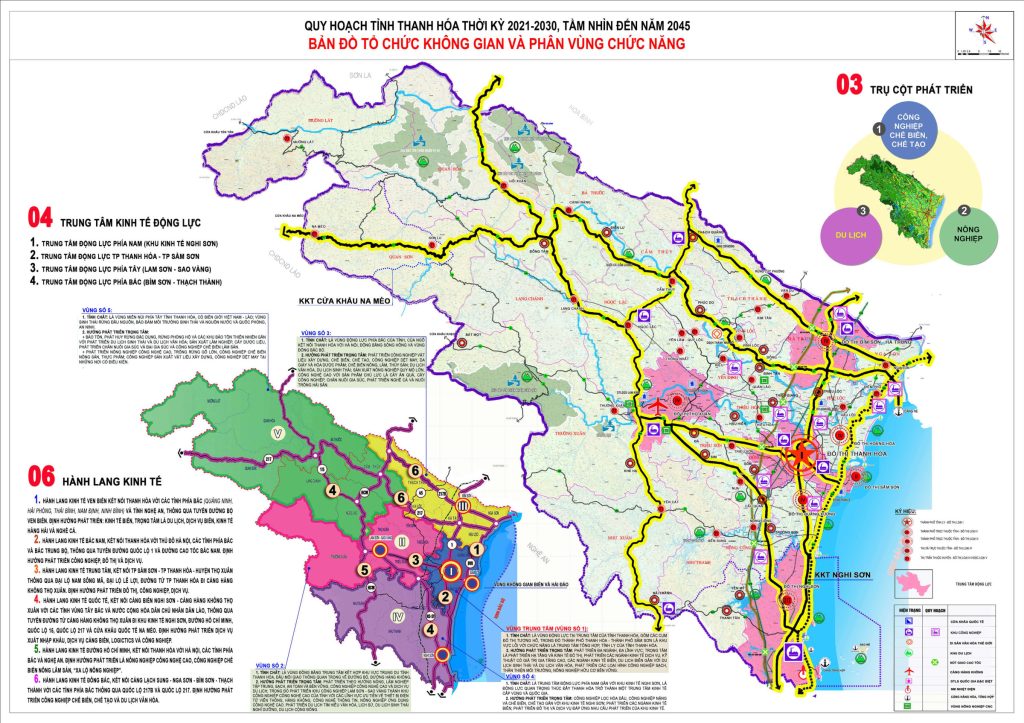
The question we hear most often when sitting down with a client is: “What’s the planning situation here?”
It is the right question, but not a sufficient one. Planning in Vietnam is a stack of documents with several layers — a layer that has been signed, a layer that is still a proposal, and a layer that exists only in a news article nobody has signed. Sellers pull out the best-looking layer. Buyers have no idea where that layer sits in the stack.
This piece sets out how we read the Thanh Hoa provincial plan — where to start, how far to trust it, and where to stop and ask more.
Which plan actually carries legal weight
At province level, the document to read first is the Thanh Hoa Provincial Master Plan for 2021–2030, with a vision to 2045, approved by the Prime Minister under Decision 259/QD-TTg dated 17 March 2023, together with the implementation plan attached to it.
That decision is the yardstick for sorting everything you hear:
- In the decision and its attached maps — approved. You can build on it.
- In the news but with no decision number — still a proposal. Listen, but do not price it in.
- Only in the seller’s pitch — nothing at all yet.
The distinction sounds obvious, but it is where most money is lost. A road that is “about to open” without an approved decision can be ten years away — or never happen.
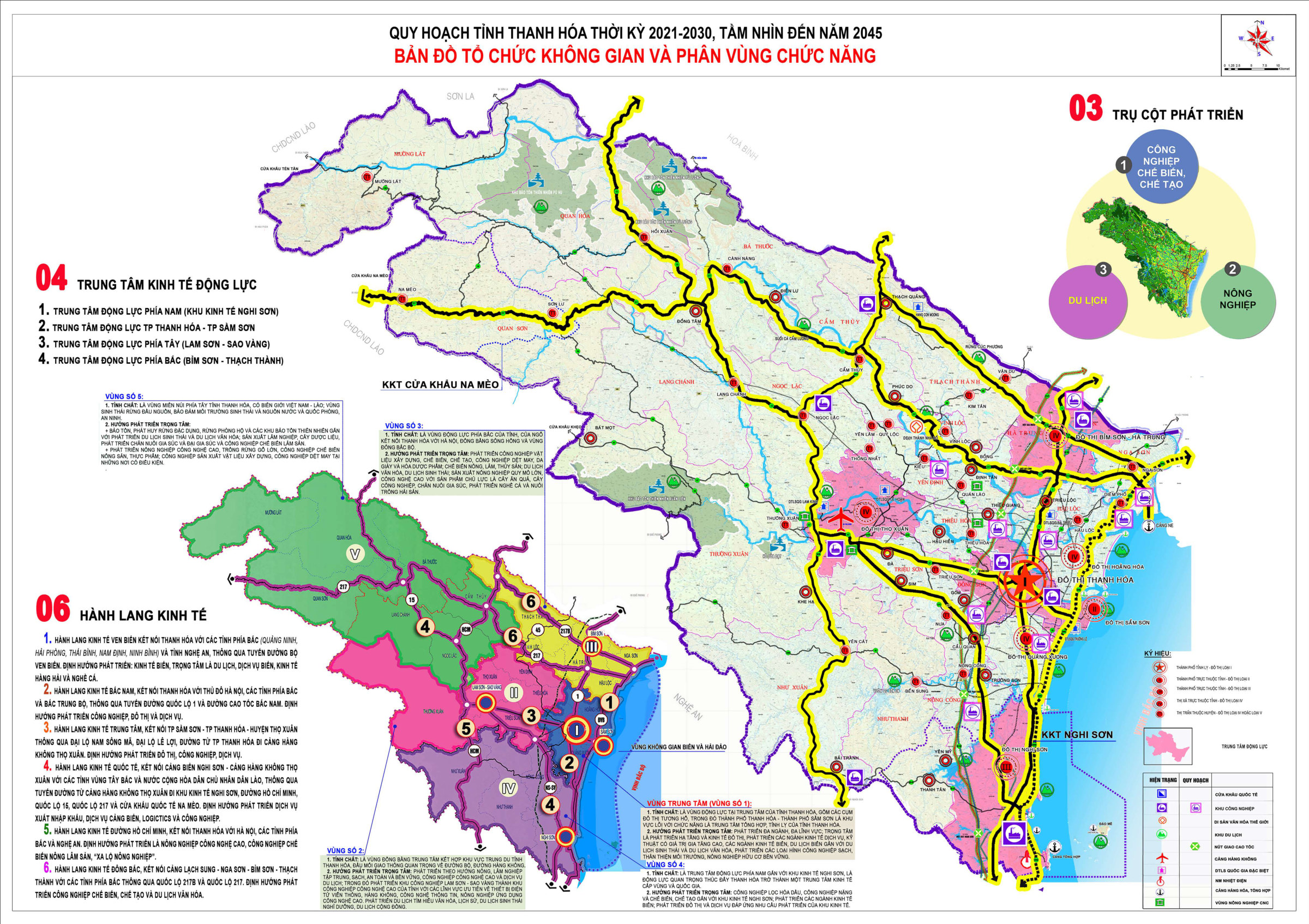
Four growth centres — read this map first
The map above is the first thing we open whenever someone asks about a plot. It says nothing about price, but it says where the province intends to concentrate its effort. According to the map, the province has four economic growth centres:
- South — Nghi Son Economic Zone. Seaport, oil refining, heavy industry.
- Thanh Hoa City – Sam Son City. The urban core and coastal tourism.
- West — Lam Son – Sao Vang. Anchored on Tho Xuan Airport.
- North — Bim Son – Thach Thanh. The gateway to the northern provinces.
Alongside these sit six economic corridors and three development pillars: processing and manufacturing, agriculture, and tourism.
What matters here: a plot inside or next to one of those four centres has a very different long-term base from a plot outside them. Not because the map is coloured more attractively, but because public budget, corporate capital and workers will move there first.
Four numbers that place the province
Before examining any particular area, know the baseline. These are the four numbers we use most often:
- Area of 11,114.71 km² — the 12th largest of Vietnam’s 34 provinces and cities under the current administrative map.
- Population of 4,320,947 — 8th nationally, per Resolution 202/2025/QH15. The labour force is around 2.7 million, or 62.8% of the population.
- Average growth of 10.24% a year over 2021–2025 — 4th in the country.
- 2025 GRDP of roughly VND 357,760 billion — 8th nationally and the highest in the North Central region.
The third number is the one we watch. Double-digit growth sustained across five years is not the profile of a province standing still. And economic growth, not a planning map, is what pulls property prices up over the long run.
Infrastructure: finished, under way, or still unbuilt
This is where buyers are led furthest astray. The same project gets described as complete when in reality it is half built. Below are several major works with their actual status, so you have a reference point.
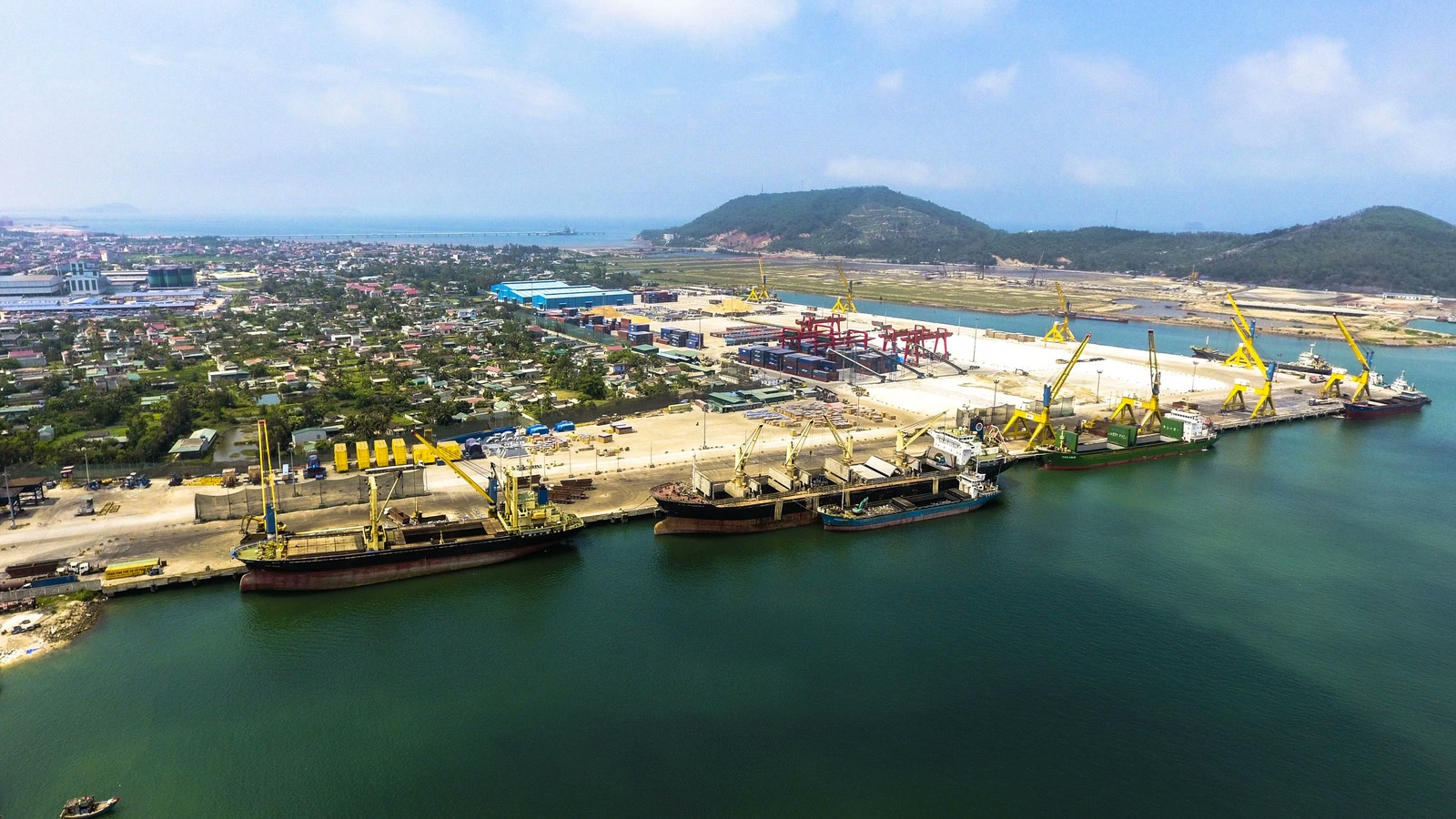
Nghi Son Port. A Class I port. In 2025 it handled more than 62 million tonnes of cargo, up 11% year on year. Provincial revenue from import-export activity exceeded VND 20,600 billion, roughly 98% of it from Nghi Son. The plan to 2030 targets 73.7–88.2 million tonnes a year.
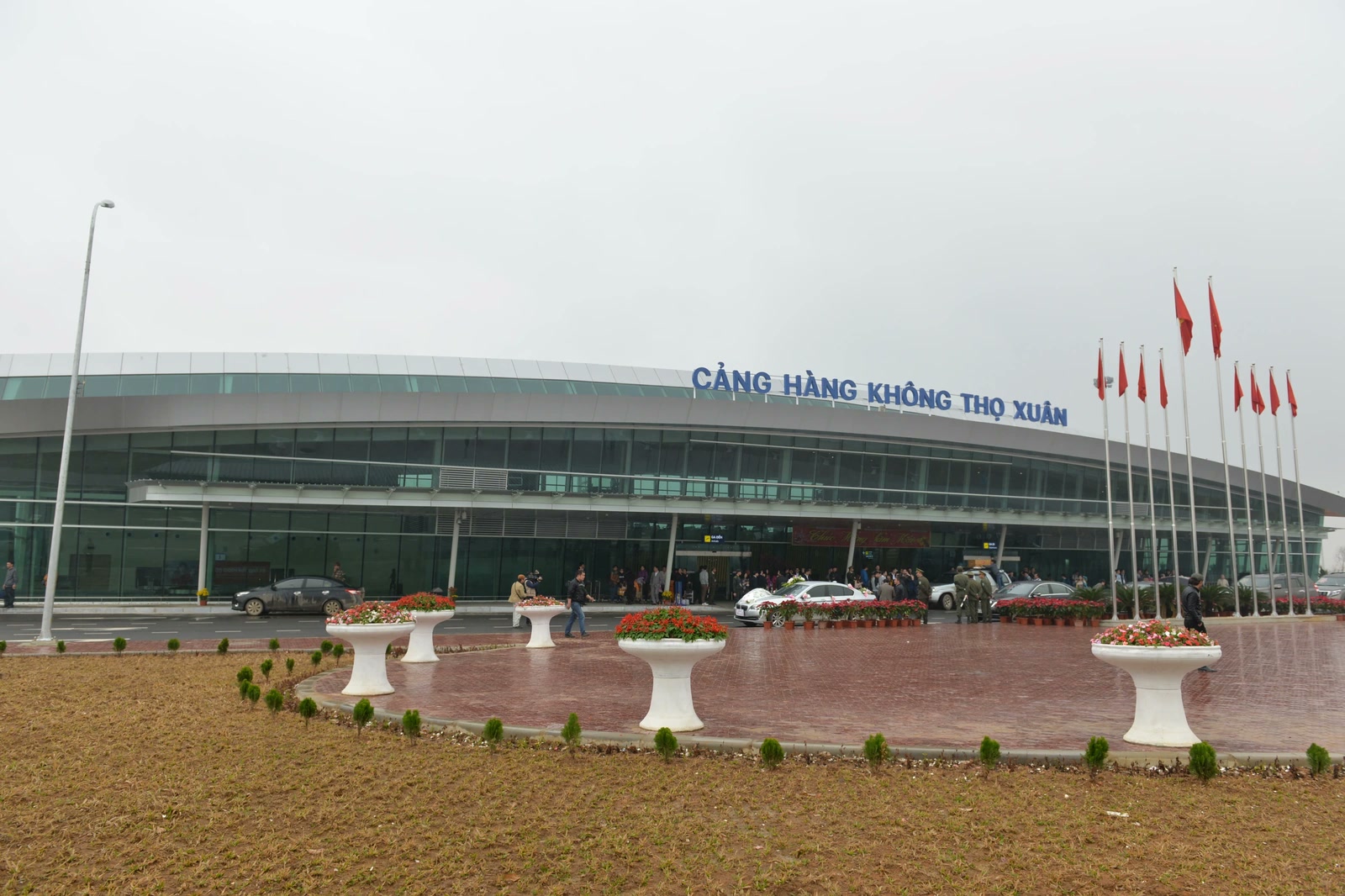
Tho Xuan Airport. Covered by Decision 648/QD-TTg dated 7 June 2023: upgraded to category 4E, capacity of 5 million passengers a year by 2030, a second runway, apron capacity expanded from 3 to 16 stands, and a new T2 terminal. This is a good example of infrastructure that carries a decision number — unlike routes that so far exist only in news coverage.
Nam Song Ma Boulevard. Over 17 km in total, 67–70 m wide, eight traffic lanes, connecting the city to Sam Son. Phase 1, running 14.617 km, opened in 2016. Phase 2, the Quang Hung – Quang Tam section, covers more than 6 km at a cost of VND 1,443 billion.
The coastal road. The Thanh Hoa section runs 96.2 km at delta grade III standard. Roughly 53% of the work is complete, with 29.9 km not yet started. That 29.9 km is the figure coastal land sellers rarely mention — and it determines whether a road actually reaches your plot within the next five years.
Aeon Mall Thanh Hoa. Over VND 4,157 billion of investment, a 10.5 ha site, around 120,000 m² of floor area, 52,000 m² of leasable space, five floors above ground and one basement, construction started in December 2024. It occupies the largest land area of any Aeon Mall in Vietnam.
When a foreign group puts that kind of money into a location, it is not looking at this year. It is looking twenty years out. That is a signal worth reading — but a signal about the region, not a guarantee for a specific plot a few kilometres away.
Planning does not raise prices by itself
We will be blunt here, because it cuts against how a lot of selling is done.
An attractive plan does not raise land prices. What raises prices is people actually moving in, real jobs, and infrastructure already running. A plan only tells you where those things are likely to appear.
On price levels, Thanh Hoa currently sits at roughly 35% of Hanoi, 50% of Quang Ninh and 60% of Hai Phong for comparable locations. That gap is headroom — but headroom does not convert itself into profit. It converts only where infrastructure genuinely arrives, and only for buyers who choose the right type of asset.
Three questions before you trust a map
When someone opens a planning map in front of you, ask these three:
- Which decision does this map belong to, and what date? If they cannot give you a decision number, it is not a legal basis — it is a sales document.
- What percentage of the work is actually complete? “Under way” and “53% complete, with 29.9 km not yet started” are very different statements.
- How far is my plot from that project, and is there a road connecting to it? Plenty of plots sit beside a major project on the map with no real access.
None of this requires expertise. You only have to ask and wait for the answer. A seller who answers precisely is worth listening to further. One who talks around it has already told you where you stand.
Then come the three tests
Planning is only the first step. Once you know where a region is heading, a specific asset still has to pass the three tests we apply in every case:
- Safety — legal status, title, planning restrictions, access. If it is not clean, stop; do not discuss price.
- Long-term growth — infrastructure, population, jobs. In an approved document, or not.
- Something you can pass on — is the legal status clean enough that the next generation never has to argue about it, does it carry a financial obligation, and can your children hold it without your expertise.
A plot in a well-planned zone with unresolved legal status still fails the first test. A good map does not fix a bad title.
We write about these three tests in more detail on our About page.
What to do next
If you are considering land in Thanh Hoa, do these three things before you commit:
- Ask the seller for the decision number behind the planning map they show you. Write it down.
- Check the real status of the nearest infrastructure project yourself — what percentage is done, how much remains.
- Visit the site and look at the access. A map will not tell you whether that road exists yet.
None of it costs money. It costs an afternoon. And it filters out most of the overpriced purchases we have watched people make.
If you want a second opinion before deciding, get in touch. To follow what is changing on the ground, the Planning and Investment sections are where we post most often.
Sources: Decision 259/QD-TTg dated 17 March 2023 · Decision 648/QD-TTg dated 7 June 2023 · Resolution 202/2025/QH15 · Thanh Hoa Province Investment Promotion Document, Provincial People’s Committee, March 2026 · Thanh Hoa Newspaper · Nhan Dan · Bao Xay Dung. Figures checked on 21 August 2026.
This article reflects the personal view of the author and is for reference only. It is not investment advice and carries no guarantee of returns. The investment decision, and the responsibility for it, are yours.